
Published on May 28, 2026
In our recent Compliance & Coffee webinar, I sat down with Alicia McCraw, Associate Attorney at Frazen & Salzano, PC, to unpack the compliance pitfalls lenders face when running promotions. Watch the recording, then read on for a summary of the key takeaways.
Why the words “contest,” “sweepstakes,” and “lottery” are not interchangeable, and what compliance teams need to know before any sweepstakes goes live.
Sweepstakes have quietly become one of the most common marketing tactics across mortgage banks, credit unions, and broker shops. They have also become one of the most frequently mishandled. Often, field officers will utilize words like “contest” or “lottery”, thinking they are synonyms when that is not the case. For sweepstakes, a single ad can sweep in UDAAP, TCPA, RESPA Section 8, state requirements and platform terms of service exposure all at once. The risks are not hypothetical, and regulators are already pulling marketing records during examinations.
Understanding the Terminology
- Sweepstakes: A prize awarded by random chance, with no consideration required from the entrant. This is the format most mortgage promotions actually fall into.
- Contest: A prize awarded based on a skill element, such as judging a photo or essay submission. Consideration is from selection; the outcome is not random.
- Lottery: A prize, awarded by chance, that requires consideration. Lotteries are generally illegal when run by private companies, and the word itself should not appear in financial institution marketing copy. Federal banking law 12 U.S.C. § 25a outlaws this practice for depositories. State lottery and sweepstakes laws (vary widely; with some states heavily restricting any "chance + consideration + prize" promotion).
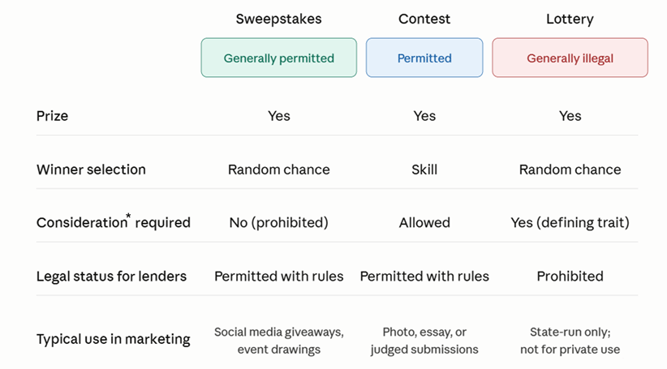
*What "Consideration" Means
It's essentially what the participant has to give up or do to enter. There are two flavors courts recognize:
- Monetary consideration — paying money, buying a product, making a deposit, paying an entry fee. This is the obvious form.
- Non-monetary consideration — doing something of substantial value or effort for the promoter. This is where it gets tricky and varies by state. Examples that might count: filling out a long survey, attending a sales presentation, providing detailed personal information for marketing, traveling somewhere specific to enter.
Common Disclosure Requirements
Sweepstakes require clear, specific disclosures so participants understand the terms of the promotion, including eligibility, entry requirements, prize details, and how winners will be selected and notified. The exact disclosures may vary depending on the structure of the sweepstakes and applicable state or platform requirements, but some common examples are outlined below:
- “No purchase necessary”
- “Making a purchase does not increase chances of winning”
- Description of the sweepstakes and identification of the sponsor
- Entry deadline and eligibility rules
- Odds of winning
- Prize details, including approximate retail value and number of prizes
- How the winner will be notified
- A free alternative method of entry should be included to reduce “consideration” risk.
Remember: the official rules need to be customized to the specific sweepstakes; there is no universal template. Always be mindful of protected classes as you evaluate eligibility rules.
Exam Trends
State regulators have begun pulling marketing records during routine exams, particularly around lender-hosted events where giveaways are common. UDAAP enforcement, based on the exam manual, continues to focus on deceptive marketing and unclear eligibility, and the Federal Financial Institutions Examination Council Social Media Guidance remains the anchor document for how examiners frame these reviews.
The Operational Burdens
Ensuring a sweepstakes is held compliantly, there are many guardrails to put in place and nuances to consider. For many teams, these arduous requirements for researching state regulatory requirements and monitoring the event from start to conclusion are too operationally burdensome for the institution to support. Many institutions have prohibited these types of practices due to resource constraints, even if the practice would be feasible in a particular jurisdiction.
However, compliance teams that have the resources and ability to approve promotions on a case-by-case basis, with documented official rules, can take steps to mitigate risk. The following key recommendations provide some guidance on how disciplined compliance teams navigate these requests today.
Key Recommendations
Official Rules: Every sweepstakes requires customized official rules covering the “no purchase necessary” statement, sponsor identification, entry deadlines, eligibility, odds of winning, prize retail value, and the winner notification process. When organizing a sweepstakes
Consideration: Consideration is not limited to money. Lengthy surveys, mandatory loan applications, or significant time investment can all qualify. A promotion limited to “new borrowers” is a frequent flashpoint because the application itself functions as consideration. An alternative free entry method must always be available.
Fair Lending: When deciding eligibility rules, compliance teams should remember to be mindful of protected classes.
RESPA Section 8: Not all sweepstakes are targeted at consumers. Always be mindful of “who is the audience”. A sweepstakes targeted at real estate agents cannot be limited to referral sources. Eligibility must extend to a broader geographic pool, such as all agents within a defined radius, and winner selection must be genuinely random rather than weighted by referral volume. See the RESPA Section 8 FAQs for additional guidance.
State Regulations: Each state jurisdiction may have its own unique requirements and disclosures. New York and Florida generally require registration and bonding for prizes, and Rhode Island outlines a prize value amount for retail promotions. Each state where a promotion might occur and be advertised should be thoroughly researched.
Platform & Medium Rules: How an event is promoted can have additional rule overlay requirements. Calling participants? CAN-SPAM. Texting? TCPA. Even online, social media platforms have their own guiding principles and requirements for promotions. Some social media platform rules would include:
- Meta: allows promotions on Professional Pages, Groups, and Events, but not on personal timelines. Required elements include a complete release of Facebook by each entrant, and acknowledgement that the promotion is in no way sponsored, endorsed, administered by, or associated with Facebook. Facebook prohibits making sharing on a personal timeline a condition of entry, and using personal timelines to administer (e.g., "share on your timeline to enter")
- TikTok: recently updated – Feb 2026 – Requires free entry and, as of February 2026, requires visible prize/eligibility disclosures on the video itself.
- LinkedIn: LinkedIn is the strictest outlier. According to LinkedIn's professional community policies, competitions, sweepstakes, contests, and giveaways are not permitted on the site.
Conclusion
Done right, sweepstakes can be a manageable compliance risk if the operational burdens tied within can be regularly achieved. The lenders treating each promotion as its own compliance review, rather than a marketing afterthought, are the ones who will stay ahead of where this enforcement curve is heading next.
Managing Social Media Compliance? SocialShield Can Help.
SocialShield monitors your team’s social media activity in real time—flagging sweepstakes, contests, and promotional posts for compliance review. Stay ahead of UDAAP, RESPA, and platform rule violations automatically.